Product comparison
Kingfisher 3D SCADA vs HT for Web (Hightopo)
Evaluating HT for Web (Hightopo) against Kingfisher 3D SCADA? This page compares architecture, 3D workflow, industrial protocols, and deployment model for OT teams modernizing visualization.
Overview
HT for Web (Hightopo) has its own strengths in specific ecosystems. Kingfisher focuses on browser-native 3D SCADA with no-code configuration, native Modbus/OPC UA/BACnet/S7 drivers, and digital-twin style plant scenes for Chinese and global industrial sites.
Buyers comparing solutions usually care about engineering effort, runtime client requirements, protocol coverage, and whether 3D is a first-class workflow or an add-on.
How Kingfisher compares
Kingfisher emphasizes unified 2D+3D binding in one project with AI-assisted scene generation options.
Compared with HT for Web (Hightopo), Kingfisher targets teams that want web delivery without thick-client rollouts across many operator PCs.
Protocol pages document Modbus, OPC UA, BACnet/IP, and Siemens S7 setup—reducing integrator guesswork.
- Browser runtime vs traditional desktop SCADA clients
- Native 3D scene editing vs primarily 2D with optional 3D
- Industrial protocol landing pages and FAQ for integrators
- Domestic deployment and licensing options for China sites
3D SCADA workflow
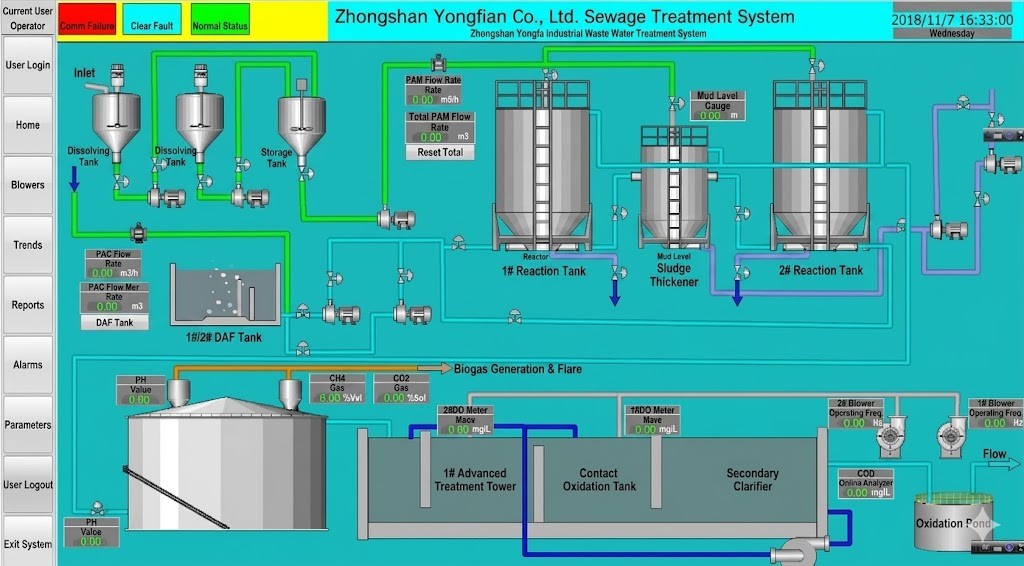
Kingfisher links live tags to 3D model properties—color, rotation, visibility—so HT for Web (Hightopo) evaluators can see operational context, not only charts.
For plants with complex piping or conveyor layouts, spatial navigation reduces training time versus flat mimic hierarchies.
Migration approach
Many teams run Kingfisher in parallel during pilot phases, importing tag lists from existing SCADA exports where possible.
- Export supervisory tag lists from the incumbent system
- Map protocols in Kingfisher driver channels
- Rebuild priority 3D views for one process unit
- Train operators, then expand scope
Evaluation notes
Feature parity with every HT for Web (Hightopo) module is not the goal—validate your required protocol, historian, and redundancy needs in a pilot.
- Run a timed pilot on your protocols
- Involve OT security early